
 English
 Русский
 简体中文
简体中文
 Français
 Español
 العربية
 Bahasa Indonesia
 한국어
한국어
 Português
 Deutsch
 日本語
日本語
 हिंदी
हिंदी
 Türkçe
 Tiếng Việt
 Italiano
 ไทย
ไทย
How to Identify a Reliable Bearing Supplier for Automotive & Industrial Projects

In automotive and industrial industries, bearings are critical components that directly influence operational stability, equipment durability, and long-term performance.
Whether for passenger vehicles, trailer systems, industrial machinery, agricultural equipment, or heavy-duty applications, selecting a dependable bearing supplier is essential for maintaining stable product quality and reducing operational risks.
However, many buyers focus primarily on pricing while overlooking factors such as manufacturing systems, engineering capability, quality consistency, and supply reliability.
For OEM buyers and aftermarket distributors, supplier selection should not be viewed as a short-term purchasing activity. Instead, it should be considered a long-term strategic partnership that affects future market competitiveness and customer satisfaction.
This article explains the most important factors companies should evaluate when selecting a professional bearing supplier for automotive and industrial projects.
Why Supplier Reliability Is Important
Bearings operate under continuous load, rotation, vibration, and environmental stress. Poor-quality bearings or unstable supply chains may lead to serious operational problems.
Potential risks include:
Premature bearing failure
Excessive operational noise
Increased maintenance costs
Unexpected equipment downtime
Warranty claims
Reduced customer confidence
For distributors and OEM companies, unstable bearing quality may also damage brand reputation and increase after-sales pressure.
Reliable suppliers help reduce these risks through stable manufacturing processes, quality management systems, and professional technical support.
Define Your Bearing Requirements Before Contacting Suppliers
Before evaluating any bearing supplier, customers should first clearly define their own technical and purchasing requirements.
Unclear inquiries often result in inaccurate quotations, unsuitable product recommendations, and inefficient communication. In many cases, suppliers may provide prices based on incomplete information rather than actual application needs.
For automotive and industrial projects, accurate specifications help buyers compare suppliers more effectively and reduce sourcing risks.
Before contacting potential suppliers, it is recommended to prepare the following information:
| Requirement Item | Typical Examples |
|---|---|
| Bearing Type | Wheel Hub Bearings, Tapered Roller Bearings,Wheel Bearing Kits |
| Precision Level | Standard precision or higher running accuracy |
| Material Requirement | GCr15 chrome steel, Stainless steel |
| Load Condition | Radial load, Axial load, Combined load |
| Operating Environment | High temperature, Dusty conditions, Heavy-duty operation |
| Annual Demand | Small batch orders or long-term bulk supply |
| Delivery Requirement | Standard stock delivery or customized production schedule |
Providing clear technical information helps suppliers recommend suitable products and prepare more accurate quotations.
For example, a low-cost quotation may appear attractive at first, but if the bearing specification does not match the actual operating requirement, it may eventually lead to:
Reduced service life
Installation problems
Increased maintenance costs
Abnormal operating noise
Warranty risks
Accurate specifications are essential not only for selecting the correct bearing product, but also for evaluating whether a supplier truly understands automotive and industrial application requirements.
Request Samples Before Bulk Orders
A professional bearing supplier should always be willing to provide samples before mass production or long-term cooperation begins.
For standard bearing models, samples are usually available from stock, while customized products may require additional production time or sample costs.
If a supplier refuses to provide samples or continuously delays sample arrangements without a clear explanation, buyers should carefully evaluate the supplier’s reliability and production capability.
After receiving samples, customers should inspect several important details carefully:
Dimensional accuracy — verify bore diameter, outer diameter, width, and tolerance according to ISO, DIN, or other applicable standards
Surface condition — uneven grinding marks, burrs, scratches, or surface defects may indicate unstable manufacturing quality
Product marking — unclear, inconsistent, or poorly engraved markings may suggest non-standard production or secondary rebranding
Operational smoothness — rotate the bearing manually to check for abnormal resistance, rough movement, or irregular noise
Cage workmanship — cage material, finishing quality, and assembly precision should match technical specifications without visible defects
Packaging quality — professional manufacturers usually maintain consistent labeling, batch numbers, carton printing, and protective packaging standards
Careful sample inspection helps customers evaluate manufacturing consistency and reduce potential risks before placing larger OEM or distribution orders.
Stable Quality Control Is Essential
One of the biggest differences between ordinary suppliers and professional manufacturers is quality stability.
Even small deviations in dimensions, hardness, or assembly precision may influence:
Rotational accuracy
Service life
Operating temperature
Vibration performance
Installation compatibility
Reliable manufacturers usually establish standardized inspection systems during every production stage.
Typical inspection procedures include:
Raw material verification
Hardness testing
Grinding precision inspection
Clearance measurement
Noise and vibration testing
Surface quality inspection
Consistent quality management is especially important for automotive wheel hub bearings and industrial heavy-load applications.
Common Bearing Quality Inspection Stages
| Inspection Process | Main Objective |
|---|---|
| Material Inspection | Verify steel quality |
| Heat Treatment Testing | Ensure proper hardness |
| Grinding Inspection | Improve precision accuracy |
| Assembly Inspection | Verify component matching |
| Final Product Testing | Confirm operational performance |
Engineering Support Improves Product Reliability
In many OEM and industrial projects, engineering support is just as important as manufacturing capability.
Different applications may require adjustments in:
Internal clearance
Sealing structure
Lubrication compatibility
Load performance
Operating tolerance
A supplier with engineering experience can help customers improve operational stability and reduce long-term failure risks.
Engineering support may include:
Bearing selection assistance
Application analysis
Structural recommendations
Product matching suggestions
Technical consultation
This support is especially valuable for automotive aftermarket projects and heavy-duty operating environments.
Product Consistency Matters More Than Initial Samples
Some suppliers provide good-quality samples but struggle to maintain stable production consistency during mass manufacturing.
For distributors and OEM customers, inconsistent products may lead to:
Customer complaints
Installation difficulties
Abnormal operating noise
Reduced product lifespan
Increased warranty expenses
Long-term cooperation requires suppliers with standardized process management and stable batch production capability.
Buyers should evaluate whether the supplier can consistently maintain quality across large production volumes.
Certifications and Qualifications Worth Evaluating
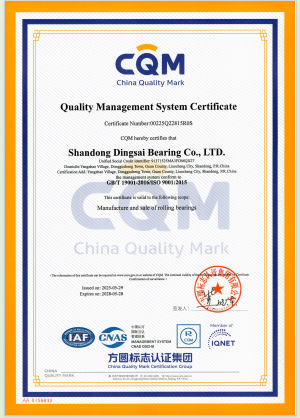
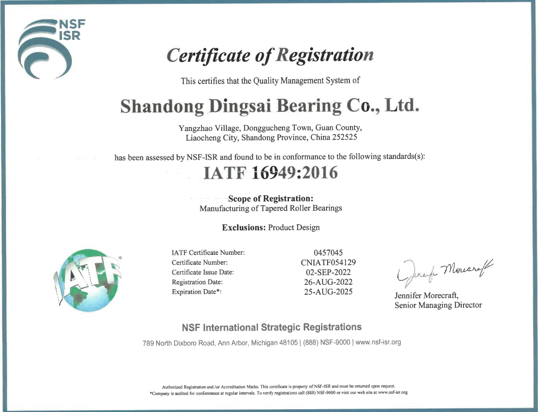
Certificates alone do not guarantee that a bearing supplier is excellent, but they do help buyers evaluate whether the company has established basic manufacturing and quality management systems.
For automotive and industrial projects, certifications should be viewed as a minimum qualification standard rather than the only decision factor.
Professional buyers should not only check whether a supplier has certificates, but also verify whether the certifications are valid, applicable, and issued by recognized organizations.
Common Certifications in the Bearing Industry
| Certification | Main Industry | Practical Significance |
|---|---|---|
| ISO 9001:2015 | General Manufacturing | Demonstrates basic quality management and process control |
| IATF 16949 | Automotive Industry | Supports defect prevention and automotive quality requirements |
| ISO 14001 | Industrial Manufacturing | Indicates environmental management capability |
| CE Compliance | European Market | Confirms compliance with certain EU market requirements |
| Brand Authorization | Authorized Distribution | Indicates official cooperation with specific bearing brands |
For most industrial and automotive bearing projects, ISO 9001 certification should be considered a basic requirement.
A supplier without a valid quality management system may struggle to maintain:
Stable production processes
Consistent product quality
Standardized inspection procedures
Delivery management
However, buyers should not rely solely on certificate copies provided by suppliers. It is recommended to verify certification validity through the issuing certification body whenever possible.
For automotive bearing applications, IATF 16949 is especially important because it emphasizes:
Process consistency
Defect prevention
Continuous improvement
Automotive supply chain management
This certification is commonly required for suppliers involved in automotive OEM projects and high-standard aftermarket applications.
When dealing with authorized bearing brands or distributors, customers should also verify whether authorization documents are current and officially recognized by the brand owner.
Reliable suppliers are usually transparent about their certifications, production systems, and quality management processes.
Communication Efficiency Is Often Overlooked
Fast and professional communication plays a major role in successful cooperation.
Customers should evaluate:
Response speed
Technical understanding
Problem-solving ability
Project coordination efficiency
Sample support capabilit
Slow or unclear communication may delay projects and create unnecessary operational risks.
Reliable suppliers usually combine sales support with technical coordination to improve project efficiency and customer experience.
Trading Companies and Direct Manufacturers Are Different
Many buyers compare trading companies and direct manufacturers during supplier selection.
Although both can provide bearing products, their operational capabilities are often significantly different.
Supplier Type Comparison
| Supplier Factor | Trading Company | Direct Manufacturer |
|---|---|---|
| Production Control | Limited | Full manufacturing management |
| Engineering Support | Basic | Professional technical support |
| Quality Stability | Depends on external factories | Controlled internally |
| OEM Flexibility | Limited | Higher customization capability |
| Delivery Management | Variable | Stable production scheduling |
| Technical Communication | Sales-oriented | Engineering-supported |
DSBR supports customers with:
Stable manufacturing capability
OEM and private label solutions
Engineering consultation
Packaging customization
Technical support
Long-term supply cooperation
We continuously improve production processes and quality management systems to support stable cooperation with global distributors and OEM customers.
Important Questions to Ask Before Choosing a Bearing Supplier
When evaluating potential bearing suppliers, buyers should ask detailed questions and request written responses whenever possible.
Written communication helps establish clear expectations and reduces misunderstandings during future cooperation.
In many cases, the supplier’s response quality, transparency, and communication efficiency reveal more than the actual answer itself.
Below are several important questions buyers should consider before establishing long-term cooperation with a bearing supplier.
Key Questions for Bearing Supplier Evaluation
Can you provide a valid ISO 9001 certificate or other relevant quality management certifications?
Is the bearing manufactured in your own factory or sourced from external suppliers?
Can you provide material specifications or inspection reports for the bearing steel used in production?
What are your normal delivery times for standard stock products and customized production orders?
How do you handle delayed shipments or unexpected delivery problems?
Do you maintain production batch traceability and inspection records for each order?
What is your standard procedure for handling customer quality complaints or technical issues?
Can you provide references from customers in similar automotive or industrial industries?
What payment terms and cooperation conditions are available for long-term customers?
How do you manage raw material shortages or supply chain disruptions during unstable market conditions?
The final question is especially important because it reflects whether the supplier has real operational planning and risk management capability.
Experienced manufacturers usually improve inventory planning, production scheduling, and supplier coordination after major market disruptions.
Suppliers who cannot clearly explain their supply stability strategy may present higher long-term cooperation risks.
Bearing Supplier Evaluation Checklist Before Cooperation
Before placing large-volume orders or establishing OEM cooperation, buyers should complete a structured supplier evaluation process.
Recommended Supplier Evaluation Checklist
| Evaluation Item | Verification Status |
|---|---|
| Bearing specifications fully confirmed | □ |
| Bearing type and application requirements clarified | □ |
| Manufacturing capability evaluated | □ |
| ISO or related certifications verified | □ |
| Sample products inspected and approved | □ |
| Material and inspection documentation confirmed | □ |
| OEM capability evaluated | □ |
| Delivery terms and lead times confirmed | □ |
| Communication efficiency evaluated | □ |
| Customer references checked | □ |
| Trial order completed before mass cooperation | □ |
A professional supplier evaluation process helps customers reduce sourcing risks, improve product consistency, and establish more stable long-term cooperation for automotive and industrial bearing projects.

